Measuring the SEO cost of a pop-up ad
Building the data pipeline
Search Console has no built-in transfer to BigQuery, so I built a lightweight ETL: a Python script on Cloud Scheduler, costing effectively nothing, landing daily SERP data in BigQuery. Daily granularity is what makes event analysis like this possible — the standard Search Console UI can't isolate a two-week window cleanly.
Impact on rank
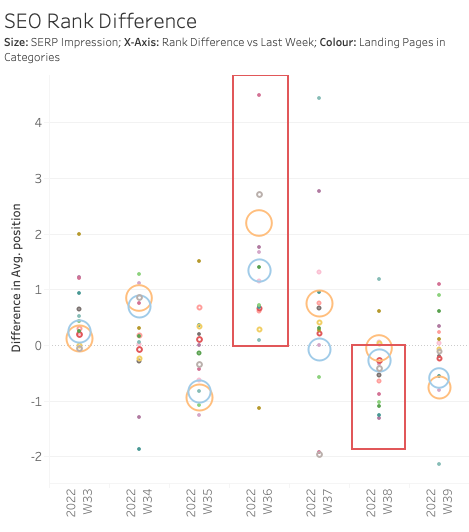
Week-to-week position changes normally hug zero. In W36 — immediately after launch — nearly all page categories lost rank, with the biggest movers dropping several positions, and a partial recovery only after the ad was withdrawn.
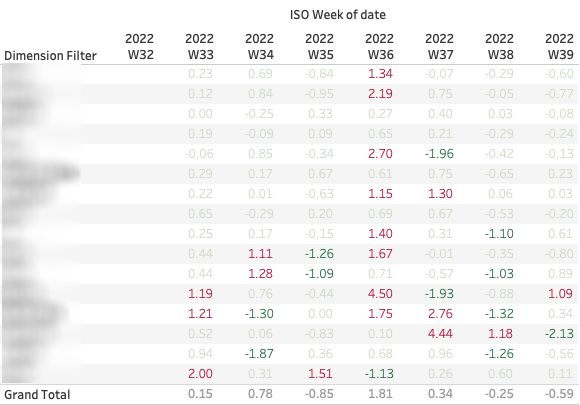
Impact on click-through
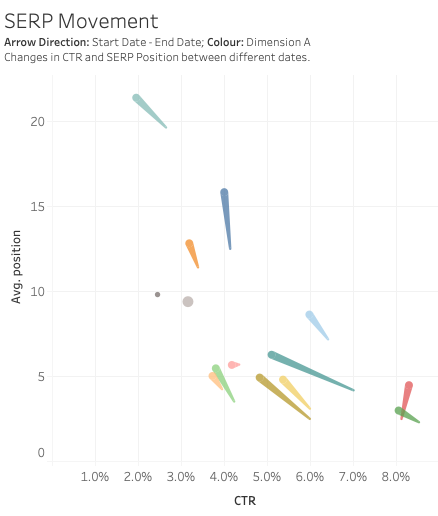
Using CTR neutralises the traffic weight of individual landing pages and isolates the change itself. The pattern is consistent: the pop-up depressed both position and click-through.
Does a stronger page resist the shock?
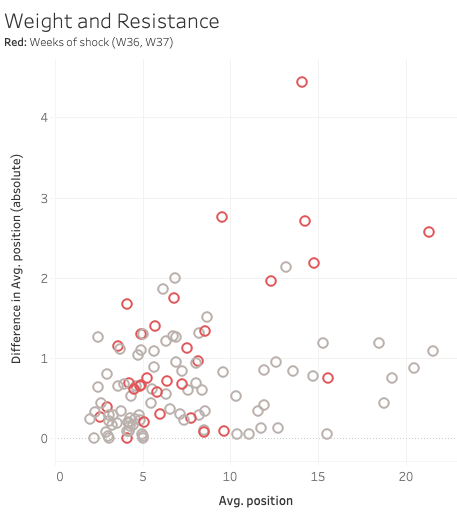
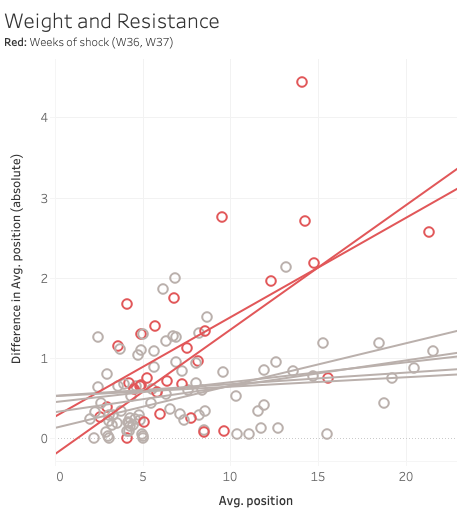
A secondary question: do high-ranking pages absorb a shock better? The relationship isn't conclusive, but the tendency was there — weaker pages fell harder in W36–W37.
Why this matters
This is the kind of analysis that settles an internal debate. "The pop-up converts" and "the pop-up hurts SEO" were both opinions until the pipeline existed; after it, the trade-off was quantified and the decision was quick. The same setup generalises to any before/after feature evaluation, query-level monitoring, or long-term SEO tracking.
← Back to all work